
The Book Town Movement
Origins, Benefits, and Examples


Cards on the table, I think I’ve become hooked on the book town movement. At the time of writing, I’ve just got home from the wonderful Wigtown on the Machars Peninsula in southwest Scotland.
It was a lovely few days buying books, walking on the beach, and chatting to book sellers and local people.
For the uninitiated, or maybe it should be the unconverted, a book town is a small, often rural town or village where secondhand and antiquarian bookstores are concentrated, drawing bibliophiles and tourists through literary festivals and related cultural activities.
These towns transform declining local economies into vibrant literary destinations. At least that’s the plan, and it seems to be largely successful.
Origins of the Book Town Movement
The movement began in 1961–1962 in Hay-on-Wye, Wales, when entrepreneur and bibliophile Richard Booth started filling empty buildings with secondhand books.
Booth, who opened his first shop in the former fire station and later acquired other properties including Hay Castle, turned the declining market town into a hub for used books.
By the 1970s, Hay had earned the nickname “Town of Books,” with dozens of bookstores. Booth’s flamboyant publicity stunts, such as declaring himself “King of Hay” in 1977, helped attract global attention.

Hay’s success inspired similar initiatives across Europe in the 1980s and 1990s, including in Belgium, France, the Netherlands, and beyond.
International collaboration grew through festivals, culminating in the formation of the International Organisation of Book Towns (now International Association of Booktowns) in 2001, following earlier gatherings like the 1998 festival in Bredevoort, Netherlands.
The organization promotes secondhand bookselling, cultural exchange, and member towns worldwide. And the movement is growing.
Benefits of Book Town Status
Achieving book town status, often through application to the international organization, brings multiple advantages:
Economic Revitalization: It attracts tourists, boosting local businesses such as shops, accommodations, and restaurants. In Hay-on-Wye, this has led to hundreds of thousands of annual visitors. In Wigtown, Scotland, property values reportedly doubled in the years following its designation, with increased private investment and a “snowball effect” on townscape improvements.
Cultural and Social Impact: Book towns preserve literary heritage, foster community events and festivals, and position small places as intellectual hubs. They support independent booksellers and create “third places” for exchange, while enhancing local identity and pride.
Tourism and Sustainability: They draw niche cultural tourists interested in authentic, scenic rural experiences, often leading to year-round events. This model helps peripheral or declining communities reclaim economic futures without relying solely on mass tourism.

Challenges remain, such as adapting to digital reading and online sales, but many towns thrive by emphasizing unique, experiential, and communal aspects of physical books.
What characterises the book towns is that they have overcome challenges, and you feel that most will do again.
Notable Book Towns Around the World
Hay-on-Wye, Wales, UK (1962): The original, with a population of around 2,000 and up to 20–30+ bookstores at peaks (offering millions of volumes). It hosts the renowned Hay Festival (since 1987), attracting tens of thousands. It remains the benchmark.
Redu, Belgium (1984): The second book town, in the Ardennes countryside. It features around 30 bookshops, a major annual festival, and was recently recognized among Wallonia’s most beautiful villages. It blends books with nature and architecture.
Wigtown, Scotland, UK (1990s designation): Scotland’s National Book Town, with over a quarter-million books across about 16 shops. It hosts a major 10-day book festival (since 1999) with hundreds of events, plus markets and smaller gatherings. It has successfully regenerated a formerly depressed area.
Hobart, New York, USA (2005): A small village (population ~400) with multiple bookstores, inspired directly by Hay-on-Wye. Local entrepreneur Don Dales and others converted empty buildings into bookshops at low rents, creating a bibliophile destination.
Paju Book City, South Korea (1989): Unique in that nearly every business relates to books (publishing, printing, shops, cafes). It stands out as a modern, purpose-built literary ecosystem.
Clunes, Victoria, Australia (2007): Hosts literary events and book-related activities; it is set to host a future International Book Towns gathering.
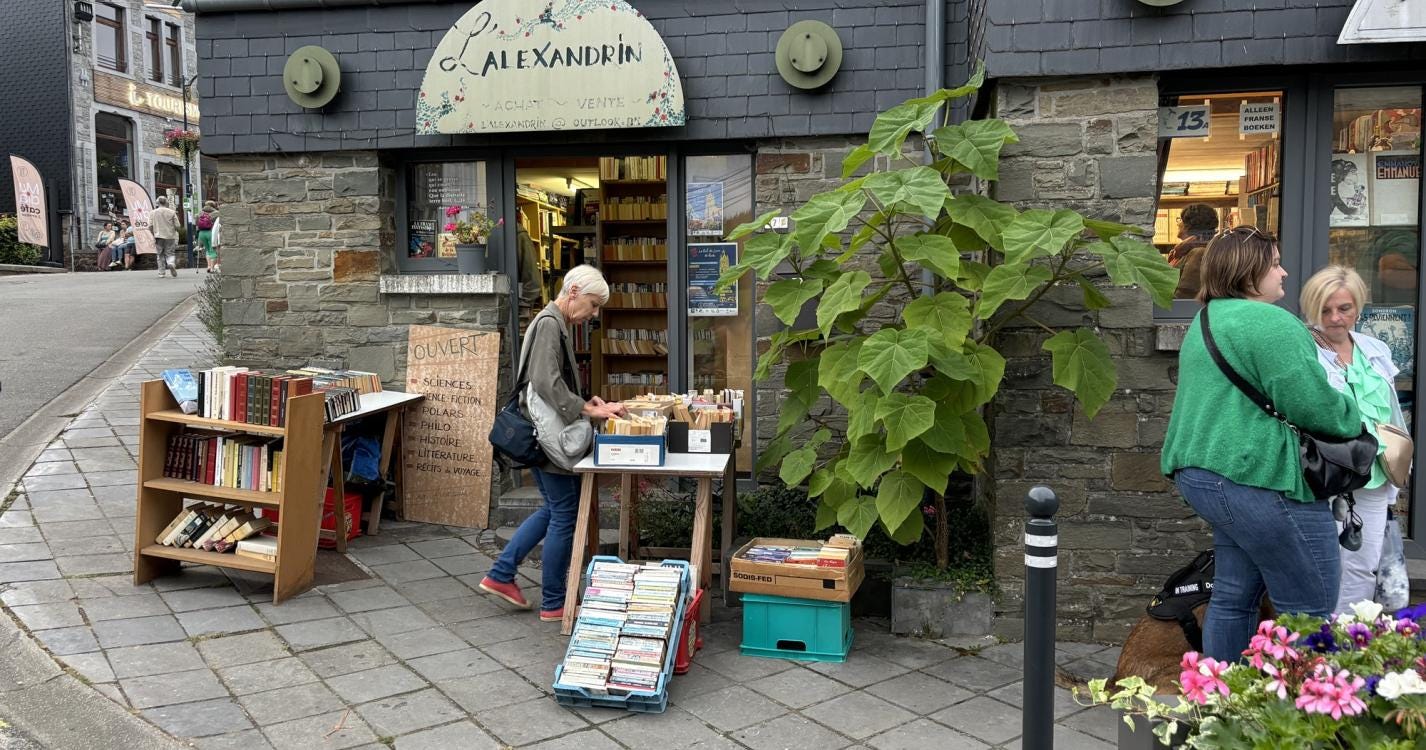
There are many more examples, and in future articles I will expand on some of them as case studies:
Montolieu, France (1991) and Fontenoy-la-Joûte, France: Early European adopters focused on revitalization.
Fjærland, Norway: Scenic fjord-side town emphasizing books and nature.
Torup, Denmark (2006): Integrated into an eco-village with innovative book distribution.
Sedbergh, England (2003): England’s book town, building on the model.
And dozens more exist globally, from Japan (Jimbōchō, with deeper historical roots) to India (Bhilar), Spain, and beyond.
Conclusion
The book town movement, sparked by one visionary in a small Welsh town, demonstrates how culture and commerce can intersect to revive communities.
My own journey into this world started with the article The Creation of Scotland’s National Book Town, which I followed up with a case study on Wigtown.
What is clear is that by concentrating bookstores and fostering literary tourism, these towns offer economic hope, cultural richness, and a celebration of the printed word in an increasingly digital age.
As the International Association continues its work, more places look set to join this global network. It will be interesting to see how large the movement can grow.
References
Frank, J. E. (2016). A study of the international book town movement [Doctoral dissertation, Griffith University]. Griffith University Research Repository. https://research-repository.griffith.edu.au/
International Association of Booktowns. (n.d.). History. https://internationalbooktowns.org/history/
National Geographic. (2025, April 9). Love reading? These are the best book towns around the world. https://www.nationalgeographic.com/travel/article/best-book-towns
Seaton, A. V. (Ed.). (2017). Book towns: Forty-five paradises of the printed word. Frances Lincoln. (Referenced in various sources)
Wikipedia contributors. (2025). Book town. In Wikipedia. https://en.wikipedia.org/wiki/Book_town
Footnotes
If you’ve enjoyed this article, please join our community and help share the message through subscribing, clicking like, and restacking to your community.
I promote the Action Learning Questions method to address complex challenges with potentially multiple answers.
Full disclosure we benefit from community members joining the Action Learning Facilitator Accreditation (ALFA) Post-Graduate Certificate with York St. John University. This helps our channel.
My latest book, Delivering Social Value in Urban Development, a collected series of essays, is published through Kindle Direct Publishing and available on most Amazon portals.
Please also check out our Concepts, Case Studies and Tools for Program Managers, Urban Planners, Policy Makers and Communities on Gumroad.
You may also like the article Communities Need Bookshops:
Communities Need Bookshops

The Front is currently one of my favourite films. It is set in the McCarthy era 1950s when the Hollywood blacklist destroyed lives and livelihoods and created an atmosphere of paranoia. Artists and writers were incentivized to snitch on each other and no one knew who to trust.
I've become fascinated by book towns! Achieving book town status brings these advantages:
Economic Revitalization: It attracts tourists, boosting local businesses such as shops, accommodations, and restaurants. In Hay-on-Wye, this has led to hundreds of thousands of annual visitors. In Wigtown, Scotland, property values reportedly doubled in the years following its designation, with increased private investment and a “snowball effect” on townscape improvements.
Cultural and Social Impact: Book towns preserve literary heritage, foster community events and festivals, and position small places as intellectual hubs. They support independent booksellers and create “third places” for exchange, while enhancing local identity and pride.
Tourism and Sustainability: They draw niche cultural tourists interested in authentic, scenic rural experiences, often leading to year-round events. This model helps peripheral or declining communities reclaim economic futures without relying solely on mass tourism.