
Small Changes, Big Impact
Small-Scale Community Initiatives That Improve People’s Quality of Life

I always enjoy conversations with Jessica Robson, the RSA’s Communities Manager. Recently we were discussing an upcoming livestream on bringing nature into cities. I was talking about grand schemes from around the world when Jess started talking about the small stuff, the inexpensive, community-led projects that change lives.
For me Jess’s observations and examples got to the heart of the matter. That in our increasingly urbanised world, where large infrastructure projects can feel distant or impersonal, the most powerful improvements to daily life often begin at the hyper-local level.
Community-led initiatives that repurpose overlooked spaces, such as back alleys behind terraced houses, demonstrate how modest investments of time, creativity, and collective effort can deliver outsized gains in safety, mental health, biodiversity, social connection, and overall well-being.
These “small changes” reduce isolation, increase safety at street level, and rebuild neighbourhood pride.
And there are some great examples of this that I’d like to share.
Bristol’s Pollinator Pathways Project
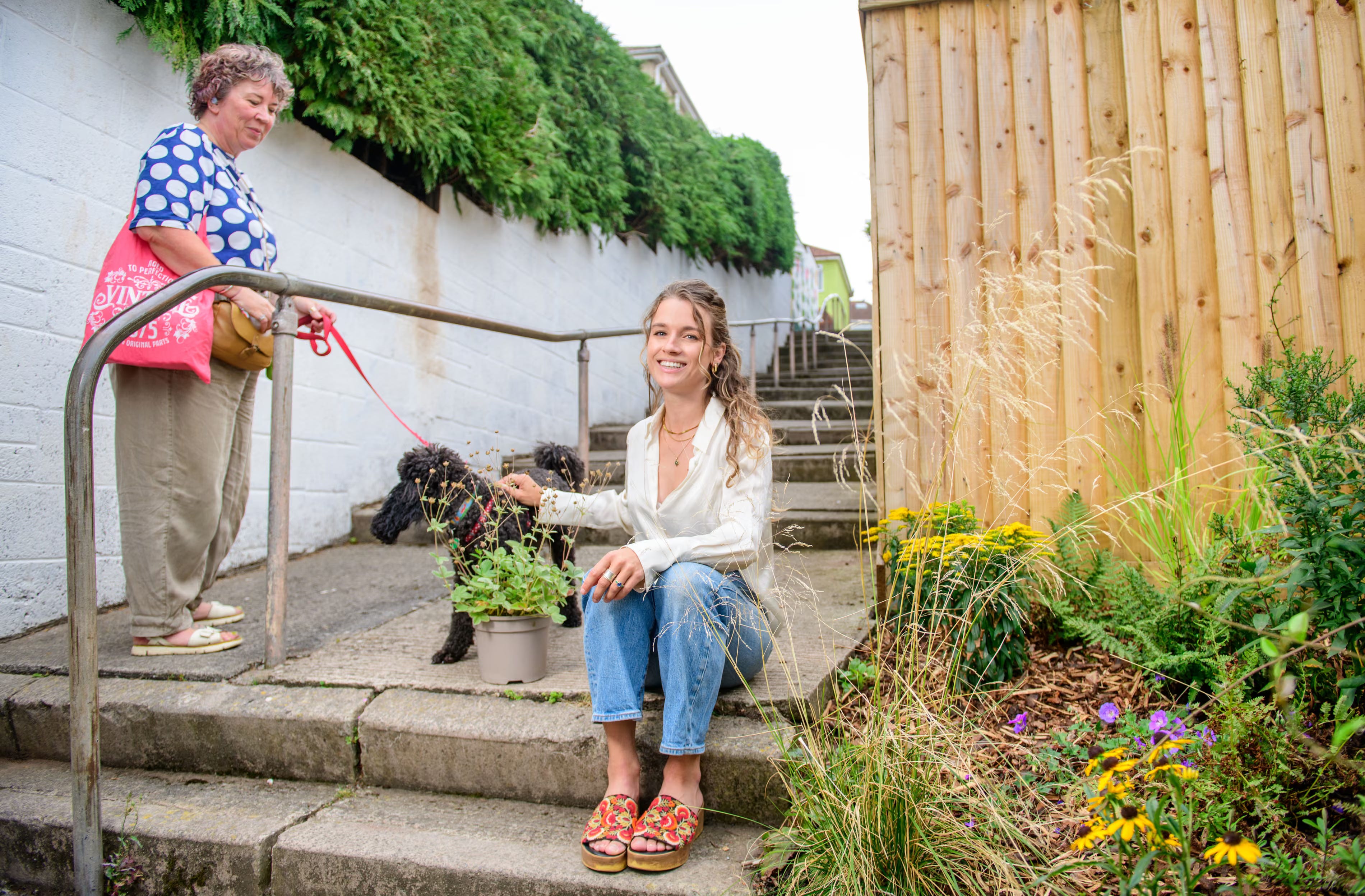
In south Bristol, what began as one resident’s response to personal health challenges and urban disconnection has blossomed into a city-wide movement.
Flora Beverley, a former ultra-marathon runner limited by chronic illness, founded the Pollinator Pathways Project around 2023 after recognising how concrete-heavy environments affected her mental health.
The initiative cleans and greens neglected alleyways, turning litter-strewn dumping grounds into nectar-rich “bee buffets” and miniature wildlife corridors that link fragmented habitats such as parks and the Northern Slopes nature reserve.
Volunteers, often entire families, clear rubbish (including drug paraphernalia and burnt mattresses in early efforts), install drought-resistant plants like catmint, yarrow, and geraniums, add bee hotels, and commission colourful murals and solar lighting.
Over a single year, seven alleyways in Knowle and surrounding areas were transformed through weekend planting days, with residents committing to ongoing maintenance such as watering and litter picking.
Funding comes from small grants (Bristol City Council and the Pollination Project Foundation), street collections, and local businesses.
The impacts ripple far beyond aesthetics. Pollinator numbers have surged, “it’s buzzing with pollinators now”, helping counteract UK insect declines while providing stepping-stone habitats for resilience against floods and fires.
Residents report stronger neighbourly bonds (many meeting for the first time during volunteer events), reduced stress through access to nature, and safer, more welcoming spaces, especially for women and children.
As Beverley notes, “The things that are good for nature tend to be very good for people too.” The project has received widespread coverage on local platforms, including Bristol24/7 (often shorthand-referenced in community discussions as B247 efforts), amplifying its reach and inspiring replication.
Middlesbrough’s Alley Transformation
Hundreds of miles north, in Middlesbrough’s terraced-house neighbourhoods, another resident-led effort shows how alleyways, traditionally sites of anti-social behaviour, can become vibrant, safe extensions of the home.
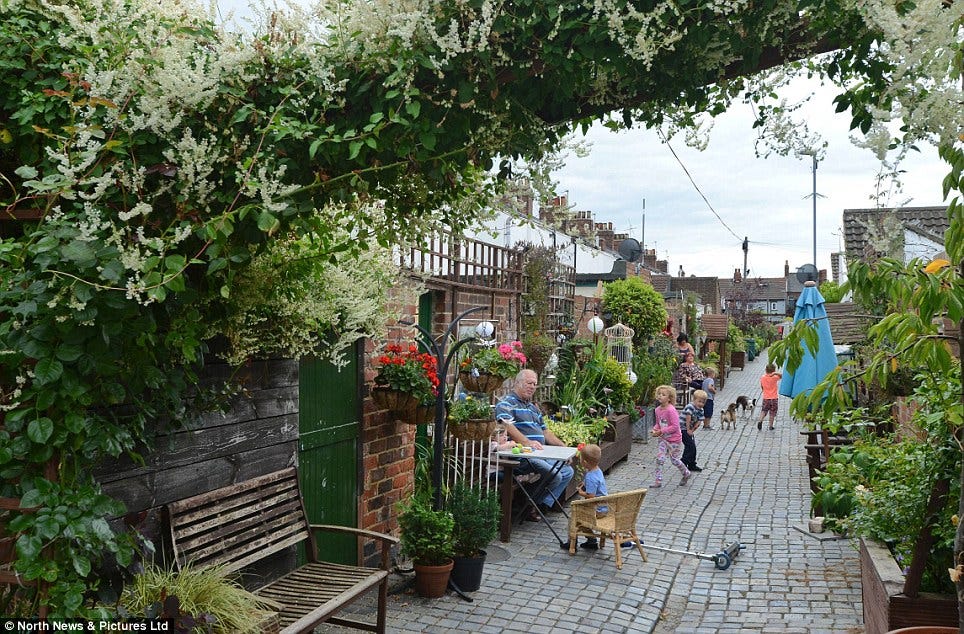
In 2021, on Camden Street, Kasper Czarnocki and his wife Kinga Czarnocka grew frustrated with their rundown back alley, plagued by rubbish, fly-tipping, pests, and isolation during lockdown. They launched an appeal via social media and posters, galvanising neighbours, children, and local artists.
With support from Middlesbrough Council’s “Amazing Alleys” scheme, the group cleaned the space, added plants, wall murals (including a chalkboard for children), seating, and play areas. Professional street artist Dan Walls contributed, and around 50 volunteers turned out for the final push.
What was once a drab, hazardous thoroughfare behind rows of terraced houses became a colourful community focal point.
The change was immediate and profound. Fly-tipping and pest problems vanished; children gained a safe outdoor play area; and older residents like 73-year-old Sheila reported life-changing reductions in loneliness: “I was lonely… So I just stayed indoors most of the time. It’s changed my life.”
Czarnocki emphasised ownership: “It won’t get done itself… take the ownership, do it yourself.” The council praised the resident-led model and encouraged more applications, leading to broader plans for 20–30 additional alleys.
Safety, social interaction, and family enjoyment improved dramatically in a neighbourhood where shared rear alleys are a defining feature of terraced housing.
Manchester’s Whalley Range Alleyways Project
Similar successes are emerging across the UK. In Manchester’s Whalley Range, the “In Our Nature” project worked with residents Paula and Jane, who had already been tidying alleys for years, to green one accessible alleyway through six workshops.
Participants built and installed water-saving wicking planters (using upcycled pallets and fly-tipped items), added biodiversity-friendly plants, a mural by a local artist, and solar-powered lighting for safety. Twenty bags of litter were cleared in one event alone.
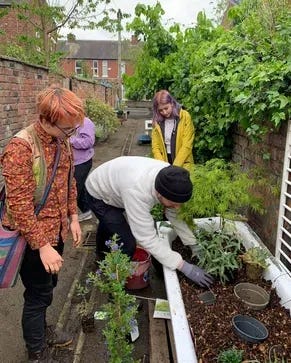
Outcomes included reduced fly-tipping (thanks to visible community care), greater climate resilience through rainwater collection, and measurable pride: 100% of surveyed participants felt positive about their neighbourhood and learned practical skills for ongoing maintenance.
Children gained safer play space, and casual interactions increased, exactly the small-scale social glue that strengthens quality of life.
Why These Initiatives Deliver Big Results
Research supports the anecdotal evidence. A study of green alleys in Belfast found they enhance community resilience by fostering collective action, improving mental health, and providing adaptive responses to climate challenges.
Low-cost, high-ownership models succeed because residents themselves identify needs, contribute labour, and maintain the spaces, creating intrinsic motivation absent in top-down projects.
Cumulative effects matter too: one greened alley inspires the next, building corridors of green infrastructure that cool streets, manage stormwater, support biodiversity, and combat urban loneliness.
These examples prove that meaningful change does not require massive budgets or central planning.
With modest grants, volunteer hours, and council facilitation, communities reclaim overlooked spaces and improve safety, health, and joy.
In Bristol, Middlesbrough, Manchester, and beyond, small changes are delivering big impacts, one alley at a time. And they were led by local people who care deeply about their communities.
References
British Broadcasting Corporation. (2021, June 19). Middlesbrough community transform rundown back alley. https://www.bbc.com/news/uk-england-tees-57527579
British Broadcasting Corporation. (2025, April 14). Bristol woman’s mission to transform UK’s ‘drab’ alleyways. https://www.bbc.com/news/articles/ckgxdr807geo
Forde, D. (2024). Alley greening: A tool for enhancing community resilience? Local Environment, 29(1), 1–18. https://doi.org/10.1080/13549839.2023.2284944
The Guardian. (2025, August 22). ‘Bee buffets’: The pollinator pathways turning drab alleys into insect havens. https://www.theguardian.com/environment/2025/aug/22/bee-buffets-the-pollinator-pathways-turning-drab-alleys-into-insect-havens
In Our Nature. (2025, October 31). Case study: Whalley Range alleyways are for everyone. https://www.inournature.uk/our-impact/whalley-range-alleyways-are-for-everyone
Pollinator Pathways. (n.d.). About the project. https://www.pollinatorpathways.co.uk/about-the-project
Footnotes
If you’ve enjoyed this article, please join our community and help share the message through subscribing, clicking like, and restacking to your community.
I promote the Action Learning Questions method to address complex challenges with potentially multiple answers.
Full disclosure we benefit from community members joining the Action Learning Facilitator Accreditation (ALFA) Post-Graduate Certificate with York St. John University. This helps our channel.
My latest book, Delivering Social Value in Urban Development, a collected series of essays, is published through Kindle Direct Publishing and available on most Amazon portals.
Please also check out our Concepts, Case Studies and Tools for Program Managers, Urban Planners, Policy Makers and Communities on Gumroad.
You may also like the article The Staircase Model for Neighbourhood Recovery:
I wanted to share examples of small changes, small projects, reduce isolation, increase safety at street level, and rebuild neighbourhood pride.
In Bristol, Middlesbrough, Manchester, and beyond, small changes are delivering big impacts, one alley at a time. And they were led by local people who care deeply about their communities.