
Hamburg's Green Network
The Benefits of Integrated Urban Greening

I’ve been writing more and more about the greening of cities. I’ve written about them in the past and have more articles and case studies coming up.
Hamburg, Germany, one of Europe’s greenest major cities, has long pursued an ambitious vision to integrate nature deeply into its urban fabric. It’s a great example to look at as a maturing green city.
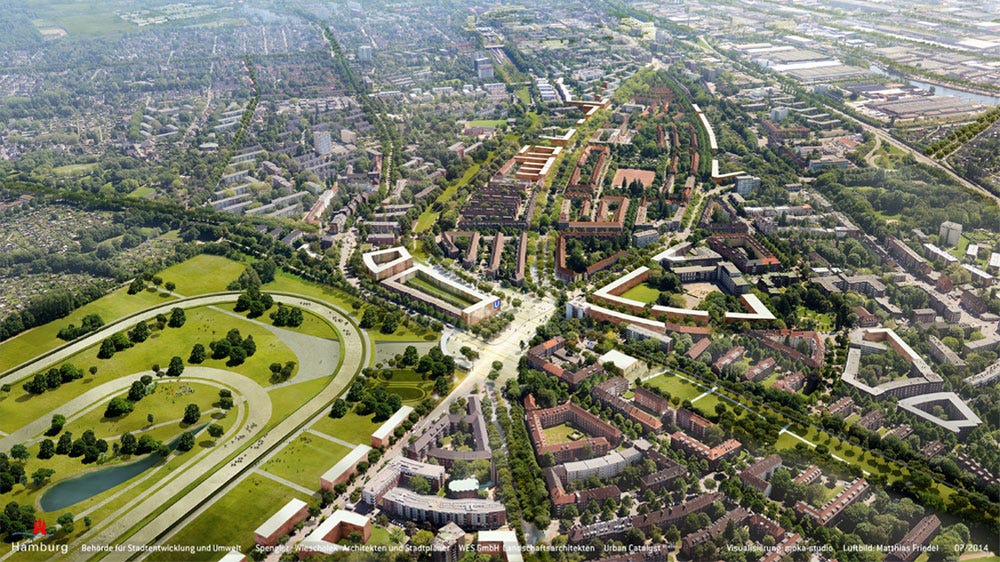
Through its Grünes Netz Hamburg (Green Network Hamburg), the city is creating and connecting an extensive system of public green spaces that covers approximately 40% of its land area.
This network links parks, recreational areas, playgrounds, gardens, cemeteries, and natural habitats via green paths, landscape axes, and rings, while enhancing accessibility by foot or bicycle and supporting the phase-out of private car use in central areas.
This integrated strategy has contributed to Hamburg’s recognition as a leader in sustainable urban development, including its designation as the 2011 European Green Capital and ongoing acclaim in smart cities contexts.
It’s the integration of greening in the city’s strategy, and the connection of green spaces that makes Hmaburg special.
Historical and Planning Principles
The foundations of Hamburg’s Green Network trace back nearly a century to city planner Fritz Schumacher’s 1919 “Axial Concept.”
This plan divided the city into residential axes separated by green interaxial spaces, parks, playgrounds, and sports fields, while establishing green corridors to connect the urban core to the surrounding countryside.
Post-World War II reconstruction reinforced these ideas with radial and circular green infrastructure. Key elements include “Landscape Axes” (green corridors radiating inward from rural areas) and “Green Rings” (circular zones for agriculture, recreation, and ecology).
This thinking advanced significantly from around 2013, when Hamburg built on this legacy within a comprehensive landscape program.
The principles emphasize connectivity (linking fragmented green spaces into a cohesive network), multifunctionality (spaces serving recreation, ecology, mobility, and climate functions simultaneously), accessibility (ensuring nature is reachable for all residents), and resilience (designing for climate adaptation amid urban pressures).
Rather than isolated parks, the network forms a “green web” that weaves through the city, prioritizing nature-based solutions over traditional gray infrastructure.
This approach aligns with broader sustainable urban planning tenets, such as compact, mixed-use development paired with high-quality public realms, reduced car dependency, and ecosystem service integration.
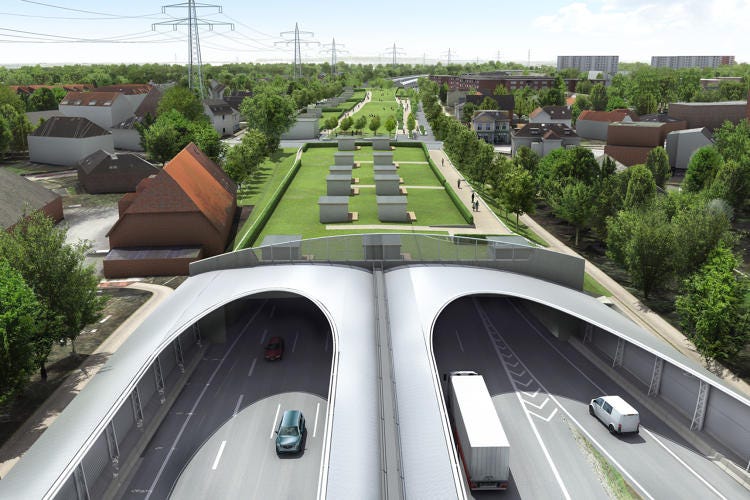
Hamburg complements the Green Network with initiatives like green roofs (targeting significant additional coverage on flat roofs), mobility strategies aiming for 80% of trips by sustainable modes (walking, cycling, public transport) by 2030, and car-reduced or car-free zones in the city centre.
Benefits
Hamburg’s Green Network delivers measurable and multifaceted benefits across environmental, social, health, and economic domains.
Environmental and Climate Resilience: The network enhances biodiversity by connecting habitats and supporting urban wildlife. It mitigates urban heat islands through shading and evapotranspiration, improves air quality, and manages stormwater.
As a port city facing rising sea levels and heavier rainfall, these green spaces absorb floodwaters and reduce runoff risks, critical given observed temperature increases and projected climate impacts. Green infrastructure also sequesters carbon and supports pollination and other ecosystem services.
Sustainable Mobility and Reduced Car Dependency: By providing car-free or low-traffic green corridors for walking and cycling, the network makes non-motorized travel practical for daily commutes and recreation. This supports Hamburg’s goal of making cars optional for many trips, lowering emissions, noise, and congestion while improving safety. City center actions, such as pedestrianizing areas and prioritizing buses and bikes, reinforce this shift.
Public Health and Well-Being: Easy access to green spaces encourages physical activity, reduces stress, and improves mental health. The network offers opportunities for hiking, picnicking, sports, and nature observation close to home, decreasing the need for car trips to distant areas. Studies and plans explicitly link such green infrastructure to better health outcomes in urban settings.
Social and Liveability Benefits: With high per-capita green space (around 114 m² per inhabitant in some assessments) and features like tree-lined streets (over 245,000 trees), Hamburg fosters community interaction and recreational activities for all. The network preserves agricultural and natural areas amid development pressures, enhancing overall quality of life and supporting tourism and local identity.
Economic Advantages: While requiring investment, the strategy yields returns through lower infrastructure costs (e.g., reduced flooding damage), higher property values in green areas, and a more attractive city for residents and businesses. It positions Hamburg as a model for sustainable growth.
Implementation
Success depends on political prioritization, coordination across departments, and balancing development pressures. Hamburg continues refining the network through updated landscape programs, green roof incentives, and mobility plans. Its long-term vision demonstrates how visionary, persistent planning can transform a dense city into a resilient, liveable green metropolis.
For me, Hamburg’s Green Network exemplifies principles of connected, multifunctional urban nature that deliver compounding benefits. As cities worldwide confront climatic, urbanization, and liveability challenges, Hamburg offers inspiration for integrating green infrastructure at scale.
The city isn’t alone in these achievements, but is a great example of staying the course, overcoming challenges and increasing green ambitions.
References
Benfield, K. (2014, January). Hamburg’s ambitious green network addresses nature, climate resilience, sustainable transportation. Smart Cities Dive. https://www.smartcitiesdive.com/ex/sustainablecitiescollective/hamburgs-ambitious-green-network-addresses-nature-climate-resilience-sustainable/213946/
Fischer, T. B. (2016). Health and Hamburg’s Grünes Netz (Green Network) plan. In Green infrastructure (pp. [relevant pages]). Routledge. (Or Liverpool repository version).
Hamburg.com. (n.d.). Green Network Hamburg. https://www.hamburg.com/residents/green/green-network-18996/
Planetizen. (2013, November 6). Ambitious network to cover 40% of Hamburg in green. https://www.planetizen.com/node/65944/
Footnotes
If you’ve enjoyed this article, please join our community and help share the message through subscribing, clicking like, and restacking to your community.
I promote the Action Learning Questions method to address complex challenges with potentially multiple answers.
Full disclosure we benefit from community members joining the Action Learning Facilitator Accreditation (ALFA) Post-Graduate Certificate with York St. John University. This helps our channel.
My latest book, Delivering Social Value in Urban Development, a collected series of essays, is published through Kindle Direct Publishing and available on most Amazon portals.
Please also check out our Concepts, Case Studies and Tools for Program Managers, Urban Planners, Policy Makers and Communities on Gumroad.
You may also like the article Prague: A Walkable City:
I’ve been writing more and more about the greening of cities. I’ve written about them in the past and have more articles and case studies coming up.
Hamburg, Germany, one of Europe’s greenest major cities, has long pursued an ambitious vision to integrate nature deeply into its urban fabric. It’s a great example to look at as a maturing green city.